

Ultraman:
City Defender.
An experiment in becoming the controller.
Body-motion tests in movement tracking and action recognition, alongside a city-scale game prototype.
Watch the gameplaySee it in play.
Final cut · Keyboard gameplay
Control setup / UI concept
Choose your controls.
Then make it yours.
The setup concept offers keyboard and motion input, then helps players get in frame, calibrate and check a punch before entering the city.
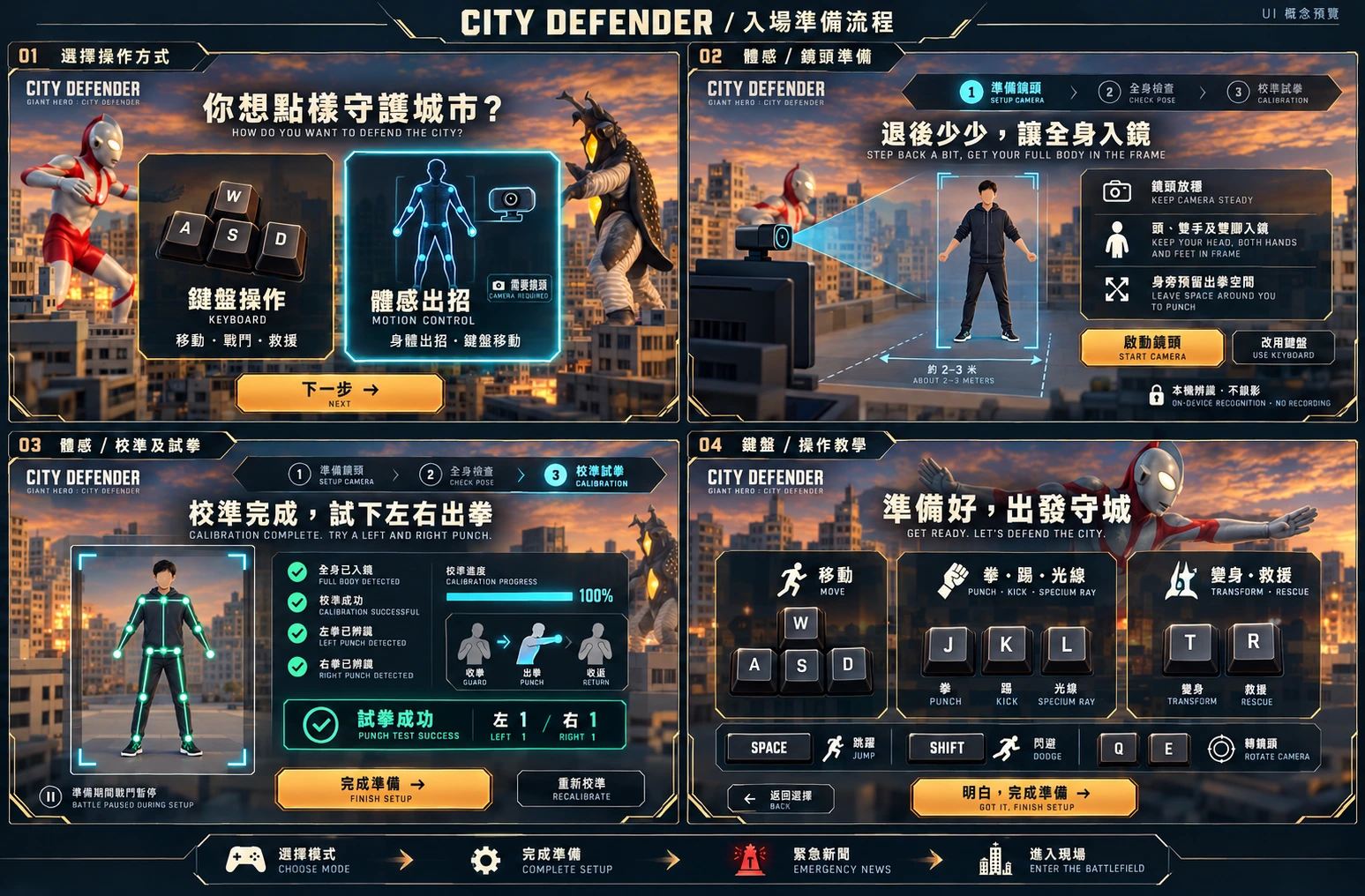
Choose
Choose keyboard controls or a hybrid of keyboard movement and body actions.
Frame
Keep your head, hands and feet in frame, with enough space to move.
Calibrate
Set a neutral stance, then check a left and right punch.
Start playing
Move with the keyboard and use body actions to test attacks.
First, make movement feel right.
01 / Follow the movement
02 / Recognise the action
Two body-control experiments: following movement and recognising actions. Recorded separately from the final keyboard gameplay.
Visual development / Environment studies
A city worth protecting.
Two environment studies explore how scale, setting and everyday places can give a giant-monster battle context.

Harbour encounter Environment study
Open water, crossing routes and boats make the scale of the encounter readable.

City and hospital Environment study
Homes, streets and a hospital shift the focus from defeating a monster to protecting the place around it.
From an idea to an experience.
Set the scene
Use visual studies to establish the city’s scale and the hero’s place within it.
Test the response
Inspect recorded tests to distinguish movement following from deliberate actions.
Guide the player
Make the control choices, camera framing and calibration steps understandable before play.